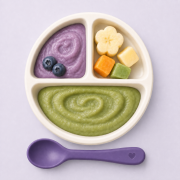
How to serve egg at 6 and 9 months
Ages are approximate; go by your baby’s skills.
6+ months
Hard-boil the egg and mash the white and yolk together with a little water or vegetable puree. You can also offer soft scrambled egg or an omelet, fully cooked with no runny parts and no hard crust. Mash the omelet or chop it finely to suit your baby’s skills.
Make a soft omelet with no runny parts and no hard crust. Cut it into long strips so part of each strip sticks out of your baby’s fist. Another option is mashed hard-boiled egg with vegetable puree on a pre-loaded spoon.
9+ months
Once your baby has developed a pincer grasp, offer small soft pieces of omelet or finely chopped hard-boiled egg. If the yolk is dry and crumbly, mix it with soft, moist food.
Choking risk
Egg should always be fully cooked, for example hard-boiled or cooked all the way through. Large firm pieces can be hard to swallow, so chop or mash egg to suit your child’s age.
Keep your child sitting upright and stay with them throughout the meal.
Allergies
Egg is one of the major food allergens. A reaction can happen even the first time your baby tries it.
Yolk first or the whole egg
Older advice often said to start with just the yolk and add the white later. Current AAP and NHS guidance has no such step: it’s about the whole egg, well cooked. The AAP gives an example of a first serving: about a third of a well-cooked egg, scrambled or hard-boiled.
Not a one-time taste, a regular food
Egg is one of the foods worth keeping in the diet, not just trying once. The NHS says that once your baby tolerates it, it should become part of their usual diet to lower the risk of allergy. The AAP advises slowly increasing the amount after a few servings with no reaction and then offering egg regularly.
In practice, egg shows up often, not once a month: in scrambled eggs, pancakes, muffins, or a frittata.
Choline
One 50 g egg has about 145 mg of choline. Babies 7 to 12 months old need about 150 mg a day.
According to USDA FoodData Central, 100 g of egg has 294 mg of choline. According to the NIH, choline is needed for the brain and nervous system. Eggs are one of the most concentrated sources in everyday food.
Runny yolks and raw batter
The FDA advises cooking eggs until both the yolk and the white are firm, and cooking egg dishes to 160°F (71°C). Young children are among those who get sicker from salmonella. So soft-boiled eggs, sunny-side-up yolks, raw cookie dough, and homemade mayo aren’t for babies.
In the UK, the NHS allows lightly cooked eggs stamped with the British Lion mark, which are produced under a code that protects against salmonella. For eggs without that mark, follow the FDA rule.
Buying and storing
The FDA recommends keeping eggs in the refrigerator at 40°F (4°C) or below and using them within 3 weeks. Skip any eggs with cracked shells.
If your baby reacted to egg
If your baby had a reaction to egg, reintroduce it only with an allergist. According to the AAP, most egg allergies go away by age 5, so a diagnosis in infancy isn’t necessarily for life.
Sources · 11
This page is based on guidance from health organizations:
- NHS — Food allergies in babies and young children
- NHS — Foods to avoid giving babies and young children
- USDA FoodData Central — Egg, whole, raw, fresh
- NHS — Scrambled egg recipe
- NHS — Baby and toddler meal ideas
- FDA — What You Need to Know About Egg Safety
- AAP — When Can Babies Start Solid Foods?
- AAAAI — Food Allergy
- AAP — When to Introduce Egg, Peanut Butter & Other Common Food Allergens
- NIH ODS — Choline
- AAP — Food Allergies in Children
For informational purposes only. Not medical advice. Decide on introducing foods, especially allergens, together with your pediatrician.